
Aditya Birla Nuvo gets board's nod, Videocon submits application.

Reserve Bank Governor Raghuram Rajan on Friday said banking sector will see major changes in the coming years.

Ajit Mishra, vice president, research, Religare Broking, answers your stockmarket queries.
With the July 1 deadline to apply for bank licence fast approaching, aspirants are scrambling to meet the Reserve Bank of India's (RBI) eligibility criteria to apply.

The pilot project for central bank digital currency (CBDC) in the retail segment went live on Thursday with the Reserve Bank of India (RBI) issuing Rs 1.71 crore to four participating banks based on their indents. The central bank has identified four banks for the first phase of the pilot - State Bank of India, ICICI Bank, Yes Bank and IDFC First Bank - in four cities, Mumbai, New Delhi, Bengaluru and Bhubaneswar. The highest indent was received from one private sector bank.

The RBI has agreed to consider the application of India Post in consultation with the government.

SBI will hold 30 per cent in RIL joint venture

Unlike any other business, banking is a turf where the captain's role is the most critical. Often a bank is defined by the personality of the CEO who runs it. Both HDFC Bank and Kotak Mahindra Bank are the creation of their CEOs, notes Tamal Bandyopadhyay.

'The snakes and ladders game will continue till the consolidation process is complete simply because we don't know how bad the scene is, with some of the banks being merged,' says Tamal Bandyopadhyay.

India Post had applied for a bank licence under RBI guidelines issued on February 22, 2013.
Time opportune, with market buoyancy and entry of new entities

Nifty crosses 9,750-mark; Bharti Airtel, TCS, Wipro, Lupin and Coal India gained the most on BSE Sensex

The RBI raked in a massive net income gain from foreign exchange currency sales as a buffer for the rupee during tumultuous geopolitical upheavals last year owing to Russia's invasion of Ukraine.

Only NIIF has stayed the course as a viable infrastructure financing institution.

Indian companies are now more confident about the execution skills of local banks.

Credit card issuers saw significant erosion of their card base during the July-September quarter as the Reserve Bank of India's (RBI) norms mandated deactivation of cards that have been inactive for a year. The second quarter of the current financial year saw outstanding cards-in-force decline by 2.55 million to 77.7 million. Prior to this, the industry, on an average, was witnessing a net addition of over 1.5 million credit cards a month as players became aggressive on the unsecured lending business after the pandemic.

With the advent of new banks, IT firms will get boostto their businesses.
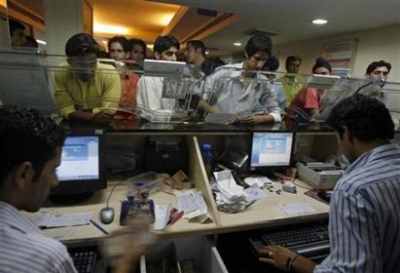
RBI had received 72 applications for small finance bank licences.

The main reason was that CPI inflation would likely remain below 4 per cent till July.

Ajit Mishra, vice president, Research, Religare Broking, answers your queries.

Telecom shares rallied on hopes that they would hike tariffs after huge investments to acquire spectrum.

Quite a few large- and mid-cap stocks are yet to recover from the note ban, pharma, banking and rural demand-based industries among laggards.

If there was one event that made the month of August stand out, it was a strengthening of the dollar index to levels last seen only 20 years ago, as the Federal Reserve dispelled all doubts about its intention to continue raising interest rates. Predictably, most currencies suffered against the US unit, with the bulk of the losers belonging to the emerging markets pack. Amid the volatility, the rupee, however, has displayed significant resilience and fared much better than most of its peer currencies.
Spending through the credit card in March 2022 jumped 48 per cent year-on-year to top Rs 1 trillion -- five months after it had hit the same figure for the first time in October 2021, buoyed by festive season expenditure. The jump has been driven by the pickup in consumption as the pandemic recedes. Expenditure in March, at Rs 1.07 trillion, was up 24.5 per cent over February, the data put out by the Reserve Bank of India (RBI) showed.

In similarly-worded notices of attachment dated October 17, Sebi asked 11 banks, including ICICI Bank, Bank of Baroda, HDFC Bank, IDBI Bank, Indian Overseas Bank and Standard Chartered Bank, to attach the accounts of the three individuals.

Omkeshwar Singh, Head, Rank MF, a mutual fund investment platform, answers your queries.

The RBI has accepted the application withdrawal request, according to the statement.

The BSE Midcap index has declined 5.7% thus far in May 2018. In comparison, the S&P BSE Small-cap index has lost 5.6%

Reliance, Birla Group, Airtel eye small finance banks.

Issuance of new bank licences proves that the apex bank wants the financial sector to flourish.
Infrastructure Development Finance Company has bagged Standard Chartered's asset management business in India for a total consideration of $205 million (around Rs 820 crore) in an all-cash deal. This deal, like the ill-fated UBS' bid last year, however, does not include StanChart's mutual fund distribution business, which the London-based bank will continue to pursue in India.

The Indian rupee is expected to trade between 80 and 84 against dollar in the first three months of 2023 with support from overseas inflows though worsening current account deficit (CAD) and reduced interest rate differential between the US and India pose challenges. According to a Business Standard Poll of 10 participants, most said the rupee could gain strength in January due to foreign inflows, and the Reserve Bank of India (RBI) is not expected to allow the currency to depreciate ahead of the Union Budget scheduled on February 1. The rupee depreciated 10.15 per cent in 2022, its worst performance since 2013 as the war in Europe and the interest rate increase by the US Federal Reserve prompted investors to flee emerging markets.

Ajit Mishra, vice president, Research, Religare Broking, answers your queries.
The outstanding credit card base dropped to 77.99 million in August from over 80 million in July, mainly on account of the new norms of the Reserve Bank of India (RBI) that warrant the deactivation of cards that are inactive for a year. While there was a 2.8 per cent decline in net card additions on a month-on-month (MoM) basis in August, a first in many months, credit card spends slipped 3 per cent on a high base. Still, spends topped the Rs 1-trillion mark for the sixth consecutive month.

The year 2022 saw the Reserve Bank of India (RBI) start acting on the policy repo rate after a gap of two years. The six-member monetary policy committee of the RBI reduced interest rate sharply - by 115 bps - when Covid-19 struck in 2020. In March 2020, days after the nationwide lockdown was announced, MPC in an unscheduled meeting reduced the repo rate by 75 bps, followed by another 40 bps in May. Status quo was maintained for the next two years since the May repo rate hike.

Weakness in the broader markets, along with expensive valuations that these companies had commanded during their IPOs, has led to this fall

The scrutiny is expected to be over this month itself.

Ajit Mishra, vice president, Research, Religare Broking, answers your queries.

Ajit Mishra, vice president, Research, Religare Broking, answers your queries.
